How Artus3D Improved Orthopaedic Manufacturing Efficiency with Raise3D RMS220

Mar 24, 2026

4

Large Covers Per Batch

One Night

Dual-Sided Housing Assembly

One Day

Deliver Parts

Company Overview

Artus3D specializes in the design and production of high quality orthopaedic devices. By combining conventional manufacturing methods with advanced additive manufacturing technologies, the company delivers tailored solutions for patients who require long lasting and comfortable orthoses.

Their work sits at the intersection of medical technology and digital manufacturing, where precision, reliability, and material performance are essential.

The Challenge: Labor Intensive Production and Material Waste

Traditionally, manufacturing orthoses and prosthetic components has been a highly manual and material intensive process. These limitations made it difficult to scale production while maintaining consistent quality.

According to Niek from Artus3D, the conventional production method involves:

  • Labor intensive one on one manufacturing
  • Low production efficiency
  • Significant material waste, sometimes up to 70 to 80 percent
  • Limited design freedom for complex geometries

Conventional subtractive processes not only consumed excessive raw material but also required multiple manual steps, increasing production time and limiting scalability.

As demand grew and operational efficiency became more critical, Artus3D began exploring industrial SLS as a long term solution.

Why SLS: Efficiency, Durability and Scalability

For Artus3D, SLS was not just about faster production. It was about achieving the mechanical performance required for medical devices that must last several years.

“Our orthoses are required to be durable and have a service life of several years, which can only be achieved through SLS printing.”

SLS delivered several decisive advantages:

  1. Increased Efficiency

With SLS, a single operator can perform work that previously required three or four people. Production becomes more streamlined and significantly less dependent on manual labour.

  1. Material Optimization

Unlike subtractive methods, SLS dramatically reduces material waste. Unsintered powder can be reused, supporting a more sustainable and cost efficient workflow.

  1. Batch Production

Traditional methods require one on one manufacturing. With SLS, multiple parts can be produced simultaneously in a single build, regardless of geometry complexity.

  1. Overnight Printing

Parts can be printed overnight and be ready the next day, improving turnaround times and enabling more predictable production planning.

  1. Design Freedom and Functional Integration

SLS enables the creation of complex geometries and the integration of different stiffness zones within a single orthosis, improving both performance and patient comfort.

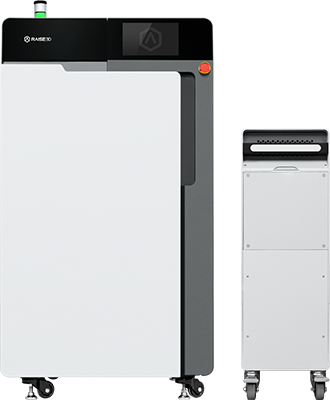
Hook Image - RMS220

RMS220

Rapid Manufacturing Simplified

Why Raise3D: Building on Existing Experience

Before adopting SLS, Artus3D was already operating two Raise3D FDM printers. Their positive experience with the ecosystem influenced the next step.

“The experience was really good, so we decided to go bigger.”

Familiarity with the software environment and confidence in the brand made Raise3D a natural choice when expanding into industrial SLS production.


Why the RMS220: Build Size and Cost Efficiency

When selecting an SLS system, two factors were decisive:

Large Build Volume

Certain prosthetic cosmetic components required a large build unit that competing systems could not accommodate. The RMS220’s build size allows:

  • Printing at least four large prosthetic cosmetic covers per batch
  • Producing full bilateral sets in a single build
  • Maximizing packing density for small components

The large build chamber supports both high volume production of small orthoses and efficient manufacturing of large prosthetic parts.

Cost Efficiency

Compared to alternative SLS systems, the RMS220 offered a cost effective solution aligned with Artus3D’s business goals, while still delivering industrial level performance.

Material Choice: Why PA11

Artus3D selected PA11 for its mechanical balance and patient focused performance.

Key properties:

  • Higher flexibility compared to PA12
  • Excellent durability
  • Sufficient stiffness for corrective support
  • High elasticity and strength

This balance is critical in orthopaedic applications.

Applications in Daily Production


Prosthetic Cosmetic Covers

Large cosmetic covers for lower limb prosthetics are one of the main applications. These components improve the aesthetic appearance of prostheses and must be both durable and lightweight.

With PA11 and the RMS220, Artus3D can:

  • Produce at least four large covers per batch
  • Complete bilateral cases in one overnight build
  • Deliver parts within a one day production cycle


Finger Orthoses

Small finger orthoses designed to prevent overextension represent another high volume application. These parts must guide movement while allowing controlled flexibility.

PA11 enables:

  • Strong yet flexible structures
  • Thin and lightweight designs
  • Improved wearer comfort

Hundreds of small parts can be nested and printed in a single batch, maximizing productivity.

Compared to conventional materials and manual processes, PA11 SLS parts are:

  • Lighter
  • More material efficient
  • Capable of integrating complex shapes
  • Able to incorporate variable stiffness in one device

Software Workflow: Familiar and Efficient

Artus3D uses ideaMaker to manage and prepare builds, continuing the workflow established with their FDM systems.

Key benefits include:

  • Familiar user interface
  • Easy file upload to the printer
  • Remote print monitoring
  • Efficient automatic nesting and packing

Previously, manual placement of parts was required in some systems. Automatic packing significantly reduces build preparation time and improves consistency.

The Result: Higher Productivity with Fewer Resources

Since implementing the Raise3D RMS220, Artus3D has achieved:

  • Significant reduction in manual labour
  • Drastic reduction in material waste
  • Batch production of both large and small parts
  • Faster turnaround times
  • Greater scalability in orthotic and prosthetic manufacturing
  • Lighter and more comfortable end products

The transition from traditional manufacturing to industrial SLS has fundamentally optimized Artus3D’s production model, combining efficiency, mechanical performance, and patient comfort.

Looking Ahead

According to Lars Broxterman:

The orthopaedic aids industry is undergoing a major shift toward 3D printing. Artus3D is continuously scaling its print farm to meet increasing demand, and the RMS220 plays a central role in that expansion.

By embracing SLS technology, Artus3D is positioning itself at the forefront of digital orthopaedic manufacturing, delivering durable, lightweight, and patient specific solutions with greater efficiency than ever before.

Connect with Raise3D

Do you have a great 3D printing success story and think it would be cool to be featured on our website? We would love to learn more! Write to us at inquiry@raise3d.com

For more information about Raise3D printers and services, browse our website, or schedule a demo with one of our 3D printing experts.

3D Printing Applications