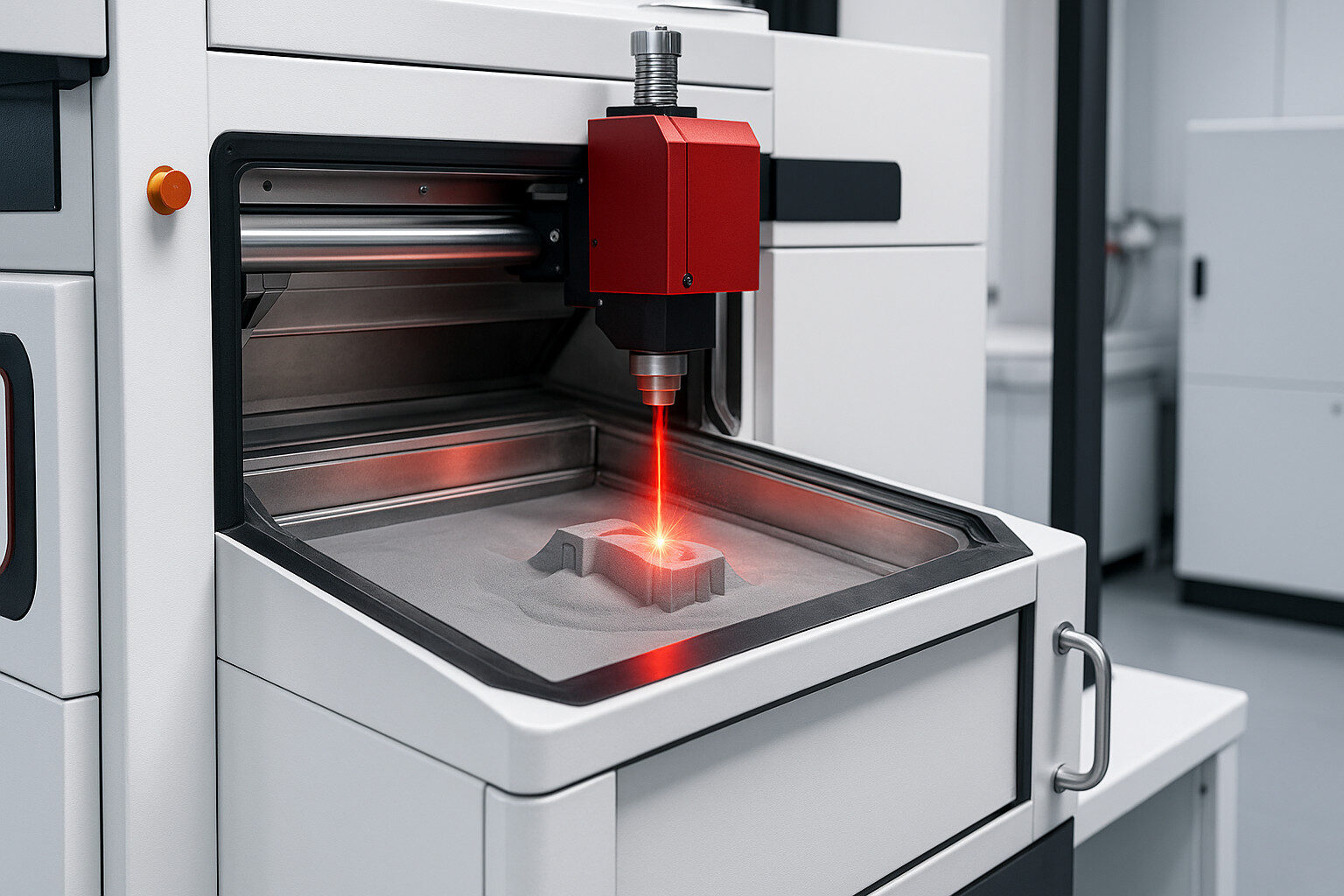
The material you choose for an SLS part decides whether that part survives its job, and a wrong choice shows up as a clip that cracks on assembly, a bracket that sags next to a motor, or a part that costs far more to print than it should.
Three factors decide most choices: the load and stiffness the part needs, how far it has to bend or flex, and the temperature it works at under load.
Chemical exposure, accuracy, finish, certification, printer limits and cost per part then narrow the shortlist. This guide takes each factor in turn, covers SLS materials beyond the Raise3D range, and ends with a comparison of Raise3D’s seven SLS powders.
Bottom line
- Start with a general-purpose nylon (PA12 or PA NEXT) and move off it only when a specific requirement rules it out.
- Move to PA NEXT or PA11 when the part must bend a lot, to a glass-bead grade when it must stay stiff or hold shape hot under load, and to TPU when it must be soft.
- Flame ratings, food contact, aggressive chemicals and sustained high heat usually point to PP, a certified grade or PEEK. If your printer can’t run those, a service bureau can.
Start With the Part, Not the Powder
Datasheets are easy to read in the wrong order. Answer these questions about the part first, then open the datasheets:
- What load does it carry, and how much can it deflect under that load?
- How far does it have to bend: once at assembly, or thousands of times?
- Does it need to be soft or rubbery?
- Which way does the load run relative to the build layers?
- What is the hottest it gets while it is loaded?
- What does it touch: oil, fuel, cleaning chemicals, water, sunlight, skin, food?
- Does it need a certificate, such as a flame rating, food-contact approval, biocompatibility or ESD protection?
Finish and cost per part come after those seven, because they only decide between powders that already pass. The sections below take the questions in order.
What SLS Can Print Beyond PA12
PA12 is the default SLS material across the industry because it sinters predictably, holds dimensions well and reuses well. It is not the only option, and some parts need something else entirely. Here is the wider range, including materials that Raise3D does not sell.
Unfilled nylons: PA12, PA11 and PA6
PA12 (nylon 12) is the most widely used SLS powder and the default choice for housings, brackets and functional prototypes. PA11 (nylon 11) is a more ductile nylon, usually made from castor oil, that gives up a little stiffness for much more stretch before breaking. Formlabs publishes about 11% elongation at break for its Nylon 12 and 40% for its Nylon 11, at a similar tensile strength of around 50 MPa (7.3 ksi). PA6 (nylon 6) is stronger and stiffer than PA12 but harder to process, so fewer machines and service bureaus run it.
Filled nylons: glass, carbon, mineral and aluminium
Filled nylons are PA11 or PA12 powders blended with glass beads or fibres, carbon fibre, minerals or aluminium to raise stiffness and heat resistance. The trade-off is elongation. Published SLS values for glass-filled, carbon-filled and aluminium-filled PA12 typically sit at 3–5% elongation, against 10% or more for the unfilled base. Carbon fibre gives the most stiffness per gram. Mineral-filled PA12 is the grade Protolabs rates best for heat deflection among its SLS nylons.
Elastomers: TPU and PEBA
TPU (thermoplastic polyurethane) is the standard flexible SLS powder, usually sold at around 90 Shore A. PEBA (polyether block amide) is an elastomer used where a part needs more rebound and softness than TPU gives.
Polypropylene
Polypropylene (PP) is a light, chemically resistant thermoplastic used for fluid-handling parts, containers and living hinges. It also resists fatigue well. The trade-off is process difficulty: it warps more and bonds between layers less strongly than nylon, and it typically needs a higher refresh rate.
High-temperature polymers: PEEK and PEKK
PEEK and PEKK are high-performance polymers for parts that work at temperatures well beyond the range of nylon, mainly in aerospace and demanding industrial service. PEEK melts at around 343°C (649°F), so it needs a dedicated high-temperature SLS system, such as EOS’s high-temperature platforms. Both the machines and the powders cost considerably more than nylon SLS.
Specialty grades
Specialty grades are nylon powders modified to meet a specific certification or electrical requirement. Examples include flame-retardant PA12 rated UL94 V-0, food-contact PA11 and PA12, PA11 with USP Class VI biocompatibility, and electrostatic-dissipative (ESD) PA11, typically 10⁶–10⁹ Ω. Whether you can get them depends on your printer’s material licence or your service bureau’s catalogue.
What a 220°C-class printer like the RMS220 can run
The Raise3D RMS220 is a compact SLS printer with a maximum powder temperature of 220°C (428°F). That range covers the PA11 and PA12 families and TPU, which is what our seven powders are: PA12, PA NEXT, PA11, PA12 GB, PA NEXT GB, TPU 86A Black and TPU 86A White. It does not cover PEEK or PEKK. PP, PA6, carbon-filled and certified grades are not in our current catalogue either.
Two routes exist for those. Under the Open Material Program the RMS220 can run selected third-party powders, and an optional fully open licence lets you run powders you qualify yourself [confirm current list of qualified third-party powders]. For anything outside the 220°C window, use a service bureau with the right machine. That limit applies to every printer in this class, including ours, and it is better to know it before you buy.
How Much Load and Stiffness the Part Has to Carry
Stiffness and strength matter because they decide whether a part keeps its shape and survives the loads it carries in service. Tensile strength tells you the load at which the material fails. Tensile modulus tells you how much it deflects on the way there. For brackets, jigs and fixtures, modulus usually decides the material, because a fixture that bends 0.5 mm (0.02 in) under clamping load is scrap long before it breaks.
The unfilled nylons all sit close together on strength. On Raise3D’s datasheets PA12 reaches 50 MPa (7.3 ksi), PA NEXT 45 MPa (6.5 ksi) and PA11 53–54 MPa (7.7–7.8 ksi). Glass beads barely move that number: PA12 GB reaches 49 MPa (7.1 ksi). What they change is stiffness. Tensile modulus rises from about 1,790 MPa (260 ksi) for PA12 to 2,800 MPa (406 ksi) for both glass-bead grades, roughly 55% higher.
Deflection under a given load scales inversely with modulus. The same bracket printed in PA12 GB deflects 1,790 ÷ 2,800 ≈ 0.64 times as far as in PA12, about 36% less, with no change in geometry. That matters because stiffening by material is often cheaper than thickening the part and pushing it past its available build space.
Materials that fit: PA NEXT GB and PA12 GB from the Raise3D range. From outside it, carbon-filled PA11 or PA12 give more stiffness per gram, and glass-fibre or mineral-filled PA12 are further options. All of them trade elongation for stiffness, which the next section deals with.
How Far the Part Has to Bend Before It Breaks
Ductility matters because it decides whether a part can bend, flex or take an impact without cracking. It is measured as elongation at break, the percentage a test bar stretches before it fails. It decides the material for snap-fits, clips, living hinges and anything that gets dropped. On Raise3D’s datasheets the range is wide:
- PA12: 6–9%
- PA NEXT: 30–36%
- PA11: 33–41%
- PA12 GB and PA NEXT GB: 3–4.5%
Here is the check for a cantilever snap-fit. Peak strain at the root is roughly ε = 1.5 × y × t ÷ L², where y is the deflection, t the thickness at the root and L the hook length. Take a hook 15 mm (0.59 in) long and 2 mm (0.079 in) thick that deflects 1.5 mm (0.059 in) to engage:
ε = 1.5 × 1.5 × 2 ÷ 15² = 4.5 ÷ 225 = 0.02, or 2%
PA12’s weakest-direction elongation of 6% leaves a 3× margin, which is fine for a clip assembled a few times. A glass-bead grade at 3% leaves 1.5×, and that hook will likely crack within a few cycles if its bending runs across the layers. PA NEXT or PA11 at 30% or more leaves over 15×, which is why they are the default for clips that get used every day. Designers commonly keep peak strain on repeatedly flexed features to a fraction of elongation at break, and the ductile grades are what give you that room.
For living hinges, PA11 and PA NEXT are the Raise3D options. From outside the range, PP is the classic living-hinge material.
Whether the Part Needs to Be Soft and Flexible
Flexibility matters because parts that grip, seal, cushion or conform must deform under load and then recover their shape, which rigid nylons cannot do. In SLS, that means an elastomer, usually TPU. Hardness is measured on the Shore A scale. Around 90A is firm, like a shoe sole: you can flex a thin section by hand, but you cannot squash a thick block.
Raise3D sells TPU 86A in black and white. On the published datasheets, the black grade reaches 9.9 MPa (1.4 ksi) tensile and 505% elongation in X, and the white grade reaches 16.5 MPa (2.4 ksi) and 616%. Measured hardness on printed parts is 90–93 A [confirm: product name vs measured hardness]. If you need softer behaviour than the material gives, change the geometry: lattice density and wall thickness set how soft an insole or helmet liner feels far more than the powder does. That is how Raise3D’s insole and helmet-lining reference parts are designed.
Two practical notes. TPU needs thicker walls than nylon; one service bureau’s design guide gives 1.5 mm (0.06 in) minimum for TPU against 0.8 mm (0.03 in) for PA12. TPU also shows more dimensional expansion than the nylons, so allow for it on mating features.
Materials that fit: TPU 86A Black and White from the Raise3D range. From outside it, PEBA gives more rebound, and softer TPU grades exist for cushioning parts.
Which Direction the Load Comes From
Load direction matters because SLS parts are usually weaker and less ductile across the build layers (the Z direction) than along them. For tensile strength the difference is small. Elongation is a different story, and it is the number that matters for anything that bends. Raise3D publishes X- and Z-direction values, so you can see the gap directly:
| Powder | Tensile X / Z, MPa (ksi) | Elongation X / Z | Elongation lost in Z |
|---|---|---|---|
| PA NEXT | 45 / 45 (6.5 / 6.5) | 36% / 30% | 17% |
| PA11 | 54 / 53 (7.8 / 7.7) | 41% / 33% | 19% |
| PA12 | 50 / 49 (7.3 / 7.1) | 9% / 6% | 33% |
| PA12 GB | 49 / 48 (7.1 / 7.0) | 4.5% / 3% | 33% |
| PA NEXT GB | 45 / 46 (6.5 / 6.7) | 4.5% / 4% | 11% |
| TPU 86A Black | 9.9 / 6.4 (1.4 / 0.9) | 505% / 293% | 42% |
| TPU 86A White | 16.5 / 10.5 (2.4 / 1.5) | 616% / 436% | 29% |
The practical rule is to orient the part so that the bending strain runs in the XY plane. When the geometry won’t allow that, design to the Z value. TPU is the case to watch: it loses about 36% of its tensile strength in Z, so a flexible strap printed standing up is noticeably weaker than the same strap printed flat. Many datasheets report only X/Y values, so ask for Z data whenever the part is loaded through its layers.
How Hot the Part Gets in Service
Service temperature matters because nylon parts lose stiffness quickly as they heat up under load: a PA12 bracket that is rigid at room temperature can start to deform at around 50°C (122°F) under heavy load. It is also the factor most material comparisons get wrong. Heat deflection temperature (HDT) is measured by heating a loaded bar until it bends a set amount, and the result depends heavily on the load. Raise3D publishes HDT at 1.8 MPa (264 psi): PA12 comes in at 51°C (124°F). Formlabs publishes HDT for its Nylon 12 at 0.45 MPa (66 psi): 171°C (340°F). Both numbers are correct for the same class of material. They are 120°C apart because the loads differ fourfold.
The mechanism explains the gap. PA12 has a glass transition at around 40–50°C, above which its amorphous regions soften. Under a light load, the crystalline structure holds the bar up almost to the melt. Under a heavy load it gives way just past the glass transition. Glass beads carry load through the softened matrix, which is why the filled grades jump at 1.8 MPa. PA NEXT GB reaches 114–115°C (237–239°F) at 1.8 MPa, against 45–48°C (113–118°F) for unfilled PA NEXT. PA12 GB’s datasheet lists 165°C (329°F) at 1.8 MPa and about 173°C (343°F) at 0.45 MPa [confirm PA12 GB thermal values].
Three rules follow from this:
- Compare HDT only at the same load.
- For a part carrying real load near heat (a bracket beside a motor, a duct clip in an engine bay), design to the 1.8 MPa value. For a lightly loaded cover, the 0.45 MPa value is closer to reality.
- HDT is a short-term test, not a continuous-service rating. Leave margin, and test the part at temperature if it matters.
Materials that fit: PA NEXT GB and PA12 GB from the Raise3D range. From outside it, mineral-filled PA12 performs well, and PEEK or PEKK on a high-temperature system is the answer when the part lives well above nylon’s range.
Chemicals, Moisture and UV in the Operating Environment
The operating environment matters because chemicals, moisture and sunlight can weaken, swell or degrade a part over time, even when it is never overloaded. PA11 and PA12 generally resist oils, fuels, greases and many common solvents, which is why they are used for automotive brackets and fluid-line clips. Strong acids and some oxidising cleaners attack nylon. Check the specific chemical, at the service temperature, against the datasheet or with an immersion test.
Moisture matters more for PA11 than for PA12, because PA11 absorbs more water, and absorbed water slightly changes dimensions and stiffness. For TPU 86A, Raise3D lists hydrolysis resistance and UV resistance, which suits outdoor and wet-environment soft parts.
Materials that fit: PA12, PA NEXT and PA11 for oil and fuel contact, and TPU 86A for wet or outdoor flexible parts. From outside the Raise3D range, PP is the choice when the part sits in aggressive chemicals.
Dimensional Accuracy and Warpage by Material
Material choice matters for accuracy because each powder shrinks, warps and expands differently as it cools, which changes how closely printed parts match the CAD model. There is no single tolerance number for SLS, and a supplier who quotes one without asking about the part is guessing. Accuracy depends on the material, the geometry, how the build is nested and how it cools. Material still sets the starting point:
- PA11 holds tighter on some fine features.
- TPU expands and deforms more than the nylons, so allow extra clearance on mating features.
- Glass-bead grades warp less on long, flat parts, because the beads reduce shrinkage.
- PP, from outside the Raise3D range, warps more than nylon.
Geometry helps too. Keeping walls near a uniform thickness, around 3 mm (0.125 in) for warp-prone parts, reduces distortion as much as a material change does. For assemblies with tight fits, print a representative sample in the candidate powder and measure it before committing a production batch.
Surface Finish, Colour and Post-Processing
Surface finish and colour matter because they decide whether a part can be used as printed or needs extra post-processing time and cost. SLS parts come out with a fine, slightly grainy matte finish and almost no visible layer lines. Most SLS powders, Raise3D’s nylons included, are black.
Finish differences between powders are real but smaller than the differences post-processing makes. PA NEXT flows better than PA12 (bulk density 0.66 against 0.52 g/cm³), and after bead blasting it often gives a finish usable for prototypes without dyeing or coating. Vapour smoothing seals the surface of PA11, PA12 and PP parts for a near-moulded finish. Dyeing works on light-coloured powders.
Materials that fit: PA NEXT for the best out-of-blaster finish in the Raise3D range. TPU 86A White when colour or a light finish matters [confirm dyeability of TPU 86A White].
One process note: PA11 printed in air instead of nitrogen shows orange peel on the surface unless you raise the refresh rate. That is covered below.
Certifications the Part Has to Meet
Certifications matter because a part that needs a flame rating, food-contact approval or biocompatibility can only be made from a powder, and a process, qualified to that standard. Check this requirement first, because it rules out powders before any other factor does. Common requirements are flame ratings (UL94 V-0), food contact, biocompatibility (USP Class VI or ISO 10993) and ESD protection.
Raise3D publishes RoHS, REACH and TSCA declarations for most of its powders. Those cover restricted substances. They are not flame, food-contact or biocompatibility certificates, and none of the seven Raise3D powders carries one of those today [confirm]. The powders listed earlier (flame-retardant PA12, food-contact PA11 and PA12, USP Class VI PA11, ESD PA11) are available from other suppliers and through service bureaus. On the RMS220, the fully open material licence lets you run a certified third-party powder you qualify yourself, such as an FDA-compliant grade.
A certificate belongs to the powder plus a validated process, not to the powder alone. Budget for the qualification work, not just the material.
What Your Printer and Facility Can Run
Printer and facility limits matter because a powder is only usable if your machine reaches its processing temperature and your site can supply the atmosphere it needs. Three constraints apply.
Temperature. The RMS220’s 220°C (428°F) ceiling covers nylons and TPU and rules out PEEK and PEKK.
Atmosphere. Nylon oxidises at bed temperature, and oxidised powder ages faster and needs more fresh powder per build. The RMS220 prints in air or nitrogen, and its built-in nitrogen generator needs a compressed-air supply. The powders differ:
| Powder | Nitrogen | Air |
|---|---|---|
| PA12, PA NEXT, PA12 GB, PA NEXT GB | Recommended | Printable, at a 50% refresh rate |
| TPU 86A Black and White | Recommended | Printable, at a 50% refresh rate |
| PA11 | Required: external supply of >99.9% purity, oxygen below 2% | Not recommended; orange peel at a 30% refresh rate |
The PA11 row is the one that surprises buyers. It needs an external nitrogen generator or tank, not just the built-in unit, which adds equipment and running cost to a powder that otherwise tests best on paper.
Changeover. Switching powders on the RMS220 takes about 45 minutes [confirm: 45 minutes vs. about 1 hour], so a lab testing several materials can do it within a shift. Keep virgin, used and blended powder for each material in separate, labelled containers to avoid cross-contamination.
What Drives Cost per Part
Cost per part matters because it decides whether a part is economical to print in a given powder, and it depends on more than the powder’s price per kilogram. Three levers decide it: powder price, refresh rate and packing density.
The refresh rate is the share of fresh powder mixed into each build. Roughly, the fresh powder you consume per build equals the refresh rate times the powder you load. Take an illustrative build with 10 kg (22 lb) of powder loaded and 1.5 kg (3.3 lb) of finished parts:
| Refresh rate | Fresh powder per build | Fresh powder per kg of parts | Raise3D powders at this rate (nitrogen) |
|---|---|---|---|
| 20% | 2 kg (4.4 lb) | 1.3 kg | PA NEXT, TPU 86A |
| 30% | 3 kg (6.6 lb) | 2.0 kg | PA12, PA12 GB, PA NEXT GB |
| 50% | 5 kg (11 lb) | 3.3 kg | PA11 (and every grade printed in air) |
So PA11 consumes about 2.5 times the fresh powder per kilogram of parts that PA NEXT does, before any difference in price. Printing PA12 in air at 50% instead of nitrogen at 30% raises fresh-powder use by about two-thirds. The model simplifies real builds, since build height and how much used powder you keep both shift the figures, but the ratios hold.
Density adds a smaller effect. PA NEXT parts come out at 1.13 g/cm³ against 1.02 g/cm³ for PA12, so the same part is about 10% heavier. Packing density adds a larger one, because the more parts you nest into each build, the more of the loaded powder turns into product. Raise3D’s reference scenarios show it:
| Reference part | Powder | Parts per build | Cost per part |
|---|---|---|---|
| Cable clip | PA11 | 192 | $1 |
| Ventilation duct | PA NEXT GB | 18 | $5 |
| Custom insole | TPU 86A White | 27 | $13 |
| Hairball trimmer housing | PA12 | 5 | $14.4 |
| Intake manifold | PA12 GB | 4 | $20.7 |
| Helmet lining | TPU 86A White | 1 | $33 |
[confirm which cost items each reference figure includes]
The cheapest part on that list is in the powder with the highest refresh rate, because 192 of them share each build. Nesting often moves cost per part more than the choice of powder.
Raise3D’s Seven SLS Powders Compared
| Powder | Tensile X / Z, MPa (ksi) | Elongation X / Z | Tensile modulus, MPa (ksi) | HDT @ 1.8 MPa | Refresh (N₂) | Air printing |
|---|---|---|---|---|---|---|
| PA12 Black | 50 / 49 (7.3 / 7.1) | 9% / 6% | ~1,790 (260) | 51°C (124°F) | 30% | Yes, 50% |
| PA NEXT Black | 45 / 45 (6.5 / 6.5) | 36% / 30% | ~1,590–1,670 (231–242) | 45–48°C (113–118°F) | 20% | Yes, 50% |
| PA11 Black | 54 / 53 (7.8 / 7.7) | 41% / 33% | ~1,690–1,880 (245–273) | 56–58°C (133–136°F) | 50% | Not recommended |
| PA12 GB Black | 49 / 48 (7.1 / 7.0) | 4.5% / 3% | 2,800 (406) | 165°C (329°F) [confirm] | 30% | Yes, 50% |
| PA NEXT GB Black | 45 / 46 (6.5 / 6.7) | 4.5% / 4% | 2,800 (406) | 114–115°C (237–239°F) | 30% | Yes, 50% |
| TPU 86A Black | 9.9 / 6.4 (1.4 / 0.9) | 505% / 293% | — | — | 20% | Yes, 50% |
| TPU 86A White | 16.5 / 10.5 (2.4 / 1.5) | 616% / 436% | — | — | 20% | Yes, 50% |
Values are typical values from Raise3D technical data sheets, tested to ISO 527-2 (tensile) and ISO 75-2 (HDT). Your parts will vary with geometry, orientation and process settings.
PA12 Black
PA12 Black is a general-purpose nylon 12 powder for functional prototypes, housings, connectors, jigs and small-batch end-use parts. It has a tensile strength of 50 MPa (7.3 ksi), 6–9% elongation at break and low warpage, which makes it a dependable default for rigid parts. It prints in nitrogen at a 30% refresh rate, or in air at 50%. Its limits are low ductility for snap-fits and an HDT of 51°C (124°F) at 1.8 MPa, so it is not suited to loaded parts near heat. Raise3D recommends PA NEXT Black as the alternative for better print performance.
PA NEXT Black
PA NEXT Black is a high-toughness polyamide powder from Raise3D for parts that bend, flex or carry load from several directions [confirm base polymer]. It has a tensile strength of 45 MPa (6.5 ksi) in all three directions and 30–36% elongation at break, about four times that of PA12. It has the lowest refresh rate of the Raise3D nylons, 20% in nitrogen, and it can also print in air at 50%. It is about 10% less stiff than PA12 and offers no advantage at elevated temperature, with an HDT of 45–48°C (113–118°F) at 1.8 MPa.
PA11 Black
PA11 Black is a nylon 11 powder for tough, impact-resistant parts, thin walls and complex geometry. It has the highest tensile strength and elongation in the Raise3D range: 53–54 MPa (7.7–7.8 ksi) and 33–41%. Typical uses are clips, living hinges, orthotic supports and thin-walled housings. It requires an external nitrogen supply of more than 99.9% purity, with oxygen kept below 2%, and a 50% refresh rate. Both requirements raise its running cost compared with the other nylons.
PA12 GB Black
PA12 GB Black is a nylon 12 powder reinforced with glass beads for stiff, dimensionally stable parts. Its tensile modulus is 2,800 MPa (406 ksi), about 55% higher than unfilled PA12, while its tensile strength stays at 48–49 MPa (7.0–7.1 ksi). It suits structural brackets, fixtures and parts that must stay flat, and it prints at a 30% refresh rate in nitrogen. Elongation at break drops to 3–4.5%, so it is not suited to snap-fits. Raise3D recommends PA NEXT GB Black as the alternative [confirm HDT and positioning].
PA NEXT GB Black
PA NEXT GB Black is a glass-bead-reinforced version of PA NEXT for stiff parts that work at elevated temperature. It has a tensile modulus of 2,800 MPa (406 ksi) and an HDT of 114–115°C (237–239°F) at 1.8 MPa. Its properties vary little with direction: elongation at break falls only from 4.5% in X to 4% in Z. It suits fixtures, brackets and ducts exposed to heat, and it prints at a 30% refresh rate in nitrogen. Like all glass-bead grades, it breaks at low strain and is not suited to snap-fits.
TPU 86A Black
TPU 86A Black is a thermoplastic polyurethane elastomer powder for soft, flexible parts. It has a tensile strength of 9.9 MPa (1.4 ksi) and stretches to 505% before breaking in the X direction. Typical uses are grippers, seals, gaskets, protective padding and footwear. It prints at a 20% refresh rate in nitrogen. Its tensile strength falls by about 36% in the Z direction, so flexing features should be oriented flat in the build.
TPU 86A White
TPU 86A White is the white version of Raise3D’s TPU 86A elastomer powder, for flexible parts where colour or a light finish matters [confirm whether it shares the black grade’s base resin]. It covers the same uses as the black grade. On Raise3D’s published data it is also stronger, with 16.5 MPa (2.4 ksi) tensile strength and 616% elongation at break in the X direction. It prints at a 20% refresh rate in nitrogen.
Raise3D also lists TPU 90A Black and now recommends TPU 86A as its replacement.
Common Parts and the Powder to Start With
| Part | Raise3D starting point | Outside option if the Raise3D range doesn’t fit |
|---|---|---|
| Snap-fit enclosure or clip | PA NEXT or PA11 | — |
| General housing or bracket | PA12 or PA NEXT | — |
| Stiff jig or fixture | PA NEXT GB or PA12 GB | Carbon-filled PA11/PA12 |
| Duct or bracket near heat, under load | PA NEXT GB | Mineral-filled PA12; PEEK above nylon’s range |
| Gasket, grip, insole, padding | TPU 86A Black or White | PEBA |
| Lightweight stiff arm or frame | PA NEXT GB | Carbon-filled PA11/PA12 |
| Part in aggressive chemicals | — | PP |
| Enclosure needing UL94 V-0 | — | Flame-retardant PA12 |
| Food-contact part | — | Food-contact PA11/PA12 |
| Electronics fixture needing ESD protection | — | ESD PA11 |
Mistakes That Lead to the Wrong Powder
- Choosing by tensile strength. The unfilled nylons are within about 10 MPa of each other. Elongation, modulus and HDT are what separate them.
- Comparing HDT figures measured at different loads. A 51°C figure at 1.8 MPa and a 171°C figure at 0.45 MPa can describe the same material.
- Ignoring the Z direction. Parts flex and fail across the layers first, and TPU loses about a third of its strength there.
- Pricing powder per kilogram instead of per part. A cheaper powder at a 50% refresh rate can cost more per part than a dearer one at 20%.
- Treating nitrogen as optional. For PA11 it isn’t, and for every grade, printing in air raises powder consumption.
Material Selection Checklist
- Peak load and allowable deflection defined
- Peak strain on clips and hinges calculated and compared with Z-direction elongation
- Softness requirement defined in Shore A, or none
- Load direction relative to the layers known, and orientation chosen
- Maximum temperature under load known, and HDT compared at the matching load
- Chemicals, moisture and UV exposure listed
- Tight fits identified for a sample print
- Finish and colour requirement defined
- Certification requirement confirmed, or none
- Printer temperature, atmosphere and nitrogen supply checked for the chosen powder
- Cost per part estimated with refresh rate and nesting, not powder price alone
Conclusion
Choosing an SLS material means matching the powder to what the part must do in service, then checking that choice against cost and against what your printer and facility can run. For most rigid parts, a general-purpose nylon such as PA12 or PA NEXT is the right starting point. Move to PA NEXT or PA11 when features must flex, to a glass-bead grade when the part must stay stiff or hold its shape under heat, and to TPU when it must be soft.
Four checks prevent most wrong choices. Compare elongation at break, not only tensile strength. Compare HDT values measured at the same test load. Design to Z-direction values when the load runs across the layers. Estimate cost per part with the refresh rate and nesting included, not from the powder price alone.
Some requirements fall outside what a 220°C-class printer can run, including flame-rated, food-contact and chemically resistant grades such as PP, and high-temperature polymers such as PEEK. For those, a qualified third-party powder or a service bureau is the practical route, and it is better to know that before buying any SLS system.
Datasheet values come from test bars, so the final check is always a printed sample of the real part. Raise3D and its resellers run sample prints on customer geometry before any purchase decision. Send the part, the load case and the finish you need, and we will print it in the two candidate powders.