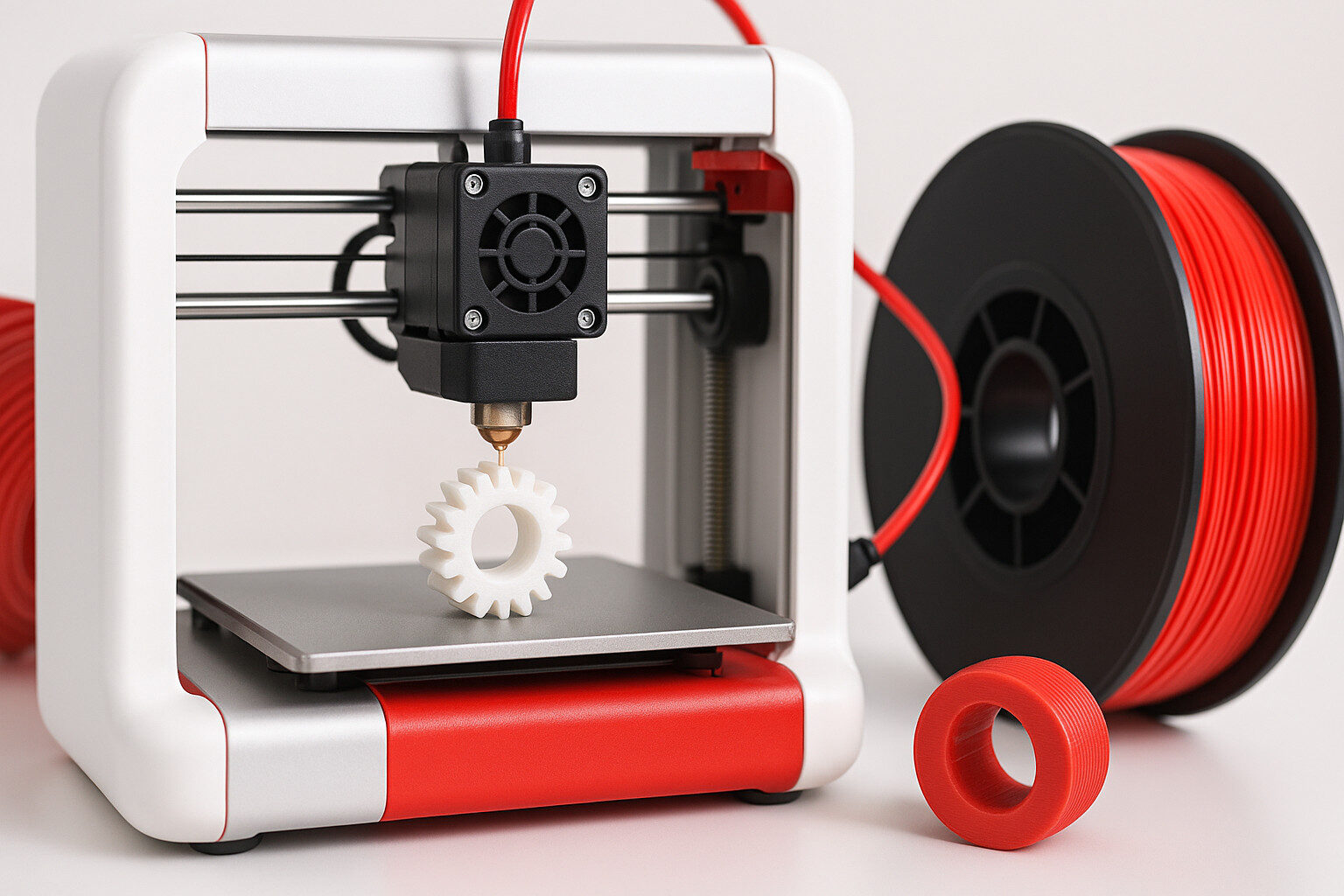
Which industrial FFF 3D printer should a UK manufacturer choose for end-use parts?
Choose the smallest supported industrial FFF printer that can repeatedly produce your hardest-to-make part in its specified material and build orientation. For a housing that fits within 450 × 350 × 400 mm, the Raise3D T450 is a candidate for a sample build; a tall one-piece part or a drawing that specifies PEEK calls for a different shortlist. [1][3]

What must the finished part survive?
Start with the drawing and the conditions of use. A cover that only keeps dust off a motor and a bracket that holds the motor can look equally easy to print. For the cover, the decisive checks might be flatness at the seal and alignment of the screw holes. For the bracket, add sustained load at the highest service temperature and repeated tightening at the inserts. A part can pass a fit check on the bench and still fail in service.
Fused filament fabrication (FFF, also called FDM) builds the part in layers. A load that pulls across layer bonds can give a different result from one applied along the deposited roads. Give each supplier the same CAD revision, service conditions, material grade, critical dimensions and acceptance limits. Ask them to mark the proposed orientation on the drawing. That makes the sample and its test results reproducible.
Which printers belong on the shortlist?
| Production requirement | Candidate and reason | Evidence to request |
|---|---|---|
| Small runs of engineering-polymer housings or covers | Consider an enclosed FFF machine sized for the part. The T450 offers a nominal 450 × 350 × 400 mm build envelope. A smaller machine can also qualify when the supported build fits. [1] | Produce the mating face and fixing holes in the intended grade. Check fit after cooling and after exposure to the specified service conditions. |
| A tall duct or shroud must be printed in one piece | Shortlist the T700 if the part fits 700 × 500 × 1,000 mm in its working orientation. The metre-long axis is vertical. For a part that must lie flat, compare the Stratasys F870 at 1,000 × 610 × 610 mm. [1] [2] |
Request the sliced build with supports and bed adhesion features. Check flange flatness, access for support removal and time until inspection. |
| The drawing requires a specific polymer | For FDM Nylon 12CF, the F870 has a documented material and build-sheet combination. For a specified PEEK or PEI grade, investigate a high-temperature platform such as the FUNMAT PRO 610HT. [2] [3] |
Get the exact grade, compatible hardware and process sheet in writing. Test a representative feature under the specified duty cycle. |
Raise3D, Stratasys or INTAMSYS for the same drawing?
Three manufacturers can quote for a large engineering part, yet the drawing may rule out two of their machines before price enters the discussion. Compare the axes in the proposed build orientation and the material grade on the drawing. The dimensions below are manufacturers’ nominal envelopes, in width × depth × height.
| Platform | Nominal build envelope (X × Y × Z) | Thermal and material workflow | Deciding trial |
|---|---|---|---|
| Raise3D T700 | 700 × 500 × 1,000 mm | 60°C maximum chamber and 420°C maximum nozzle temperature. TwinFlow feeds a single nozzle; the standard nozzle is 0.6 mm. Raise3D limits PEEK to experimental assessments and expressly excludes general large-format PEEK printing. T Series specifications and material guidance | Trial the tall duct upright. Measure sealing-face flatness and deflection after conditioning in the specified polymer. |
| Stratasys F870 | 1,000 × 610 × 610 mm | 95°C fully heated chamber, integrated drying and automatic material changeover. Stratasys lists ASA, ABS-M30, ABS Draft and FDM Nylon 12CF. Nylon 12CF requires its dedicated build sheet. F870 product specifications · Material and sheet combinations | Trial a long part lying along X. Ask the operator to record when a spool change occurred and inspect the surface and dimensions across that section. |
| INTAMSYS FUNMAT PRO 610HT | 610 × 508 × 508 mm | Heated chamber up to 300°C and dual extruder up to 500°C. Listed high-temperature polymers include PEEK and PEI 9085. These figures refer to the 610HT model. 610HT specifications | For a drawing that specifies PEEK or PEI, request the exact grade and test a loaded feature after conditioning. Check the supported build fits the 508 mm Z axis. |
Chamber and nozzle temperatures describe different parts of the machine. Neither value gives the allowable service temperature of a printed bracket. Ask for data on the proposed grade, orientation and conditioning, then test the assembled part at its specified service load and temperature.
A drawing that separates the three. Suppose a duct is 900 mm high on a 300 × 260 mm flange and the flange must print flat. The T700 passes the nominal size check in that orientation. The F870 and 610HT fail the height check. Turn the design review around: if the engineer permits the duct to lie along X, the F870 becomes a candidate. Before signing off either route, inspect sealing-face flatness and check whether internal supports can actually be removed. If PEEK is mandatory and the duct must stay upright, this shortlist has no verified one-piece solution.
How do you prove the process will repeat?
Ask for the measurements from several independent builds. Ten parts from one tray tell you about variation within that tray. Separate starts, a fresh spool and a second operator tell you more about the production process you will inherit. Agree the sample size with your quality lead according to the consequence of failure.

For a housing like the examples shown, nominate the circular seat, two fixing holes and the mating face. Record bore diameter, hole spacing and flatness after the agreed conditioning period. Assemble it with the production mating part. If the joint sees heat or vibration, repeat the fit or retention check after a representative exposure. Set pass limits from the drawing before the supplier prints.
Keep the material lot, drying record, build orientation, slicer profile, nozzle, operator and inspection results with each sample. If a supplier adjusts hole compensation to make the sample pass, retain that revision for the repeat builds. Ask who controls profile changes after installation.
| Feature on the drawing | What to record for each build | How to decide |
|---|---|---|
| Seal face and fixing holes | Flatness after conditioning, hole spacing relative to the drawing datums, inspection method and measured values. | Check each critical dimension against the released drawing. Assemble with the production mating part and inspect the seal. |
| Threaded insert or loaded boss | Insert specification, installation method, tightening sequence and condition after the agreed thermal or load cycle. | Apply the load or torque defined by the design owner. Record cracks, pull-out, movement and permanent deformation. |
| Repeat orders | Across separate starts, log machine hours, operator minutes, rejected pieces, rework and time to release the batch. | Compare accepted pieces delivered by the required date and cost per accepted piece. Keep first-off development hours visible. |
A factory example. Komax Shanghai used a Raise3D Pro3 and three E2 printers for supporting parts and fixtures on wire-processing lines. Its application note describes a mixed fleet producing 100–200 parts per week. That case shows why a buyer might choose several smaller machines for varied work. The reported output applies to Komax’s parts and equipment; T Series throughput for your parts needs its own timed build. [6]
What should a UK buyer put on the purchase order?
For a budget comparison, UK supplier 3DGBIRE listed the T450 at £4,449 excluding VAT and the T700 at £14,199 excluding VAT when checked on 27 November 2026. These are advertised machine prices. A UK quote for an industrial 3D printer should identify the exact hardware, options and delivery site before you commit funds. [4]
[5]
| Ask the supplier to confirm | What you need in writing |
|---|---|
| Delivered and installed price | GBP price, VAT treatment, carriage to your postcode, unloading, commissioning, training, drying equipment, starter material and inspection costs. |
| Delivery and site readiness | Stock or pre-order status for the exact configuration, dispatch and installation dates, access dimensions, power, ventilation and who signs off the site survey. |
| Service at your site | UK service contact, remote and on-site coverage for your postcode, response target, engineer travel charges, warranty exclusions and local spares lead times. Distinguish a response target from time to restore production. |
| Production acceptance | Attach the approved CAD revision and acceptance test. Specify who repeats the test after installation, what happens after a failed build and which records you receive. |
Compare cost per accepted part. Add material and support, machine time, operator time, finishing and inspection, including resources spent on failed prints. Divide by the number of parts that pass. For example, a hypothetical £240 batch with eight accepted parts costs £30 per accepted part, even if ten were started. Apply the same allocation of machine and service costs to every quotation.
Questions buyers ask before signing
Can a filament datasheet qualify my finished part?
A datasheet helps screen material grades. Ask how its specimens were made and conditioned. A moulded tensile bar or a printed coupon in a different orientation cannot establish how a loaded insert in your finished component will behave.
How much build volume should I leave spare?
Ask for the slicer file showing the actual part, supports, brim and permitted build area for that configuration. A nominal 900 mm duct might fit upright in the T700, yet its flange or the required orientation can rule that placement out. There is no single clearance percentage that works for every job. [1]
When is outsourcing the better purchase decision?
Get a bureau quote when demand is intermittent, a specified polymer is rarely used, or your site cannot yet inspect and release the component. Compare price and delivery for accepted parts against the full in-house cost, including downtime cover.
What should I send for a meaningful sample print?
Send the CAD file, drawing revision, material grade, mating geometry, expected monthly quantity and one written pass/fail test. For a T450 or T700 evaluation, use the sample-print enquiry on the Raise3D T Series page and ask for the build record and inspection results with the sample.
Sources
- Raise3D · T Series specifications and sample-print enquiry
- Stratasys · F870 technical support and material combinations
- INTAMSYS · FUNMAT PRO 610HT specifications
- 3DGBIRE · T450 UK listing
- 3DGBIRE · T700 UK listing
- Raise3D · Komax Shanghai application note (PDF)
- Stratasys · F870 chamber and material-handling specifications